

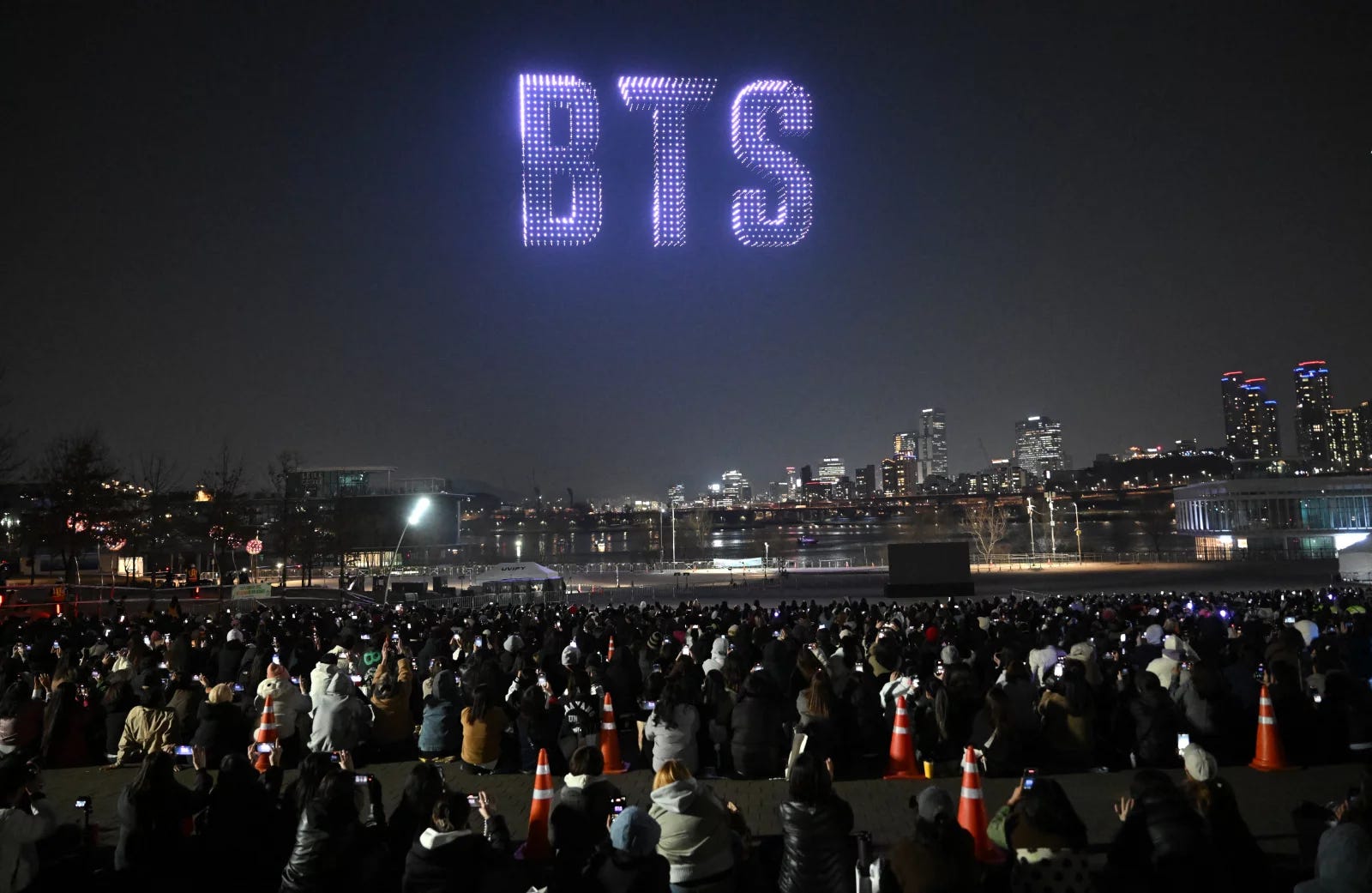
Last month, I joined the ARMY…the BTS ARMY. I know I know - BTS have been a phenomenon for over a decade now, and I am very late to the game (shame on me!) My entry point was watching the Netflix BTS comeback live stream…then came Arirang on repeat, then fan edits, and RunBTS… now I’m hooked.
https://www.npr.org/2026/03/20/nx-s1-5753931/bts-arirang-comeback-k-pop
Which got me thinking, what can we learn from the BTS ARMY? Is there a formula for fandom? And how does fandom guide the behavior of GenZ/ Alpha and what trends are we seeing in the shifts in how fandoms are formed? According to a recent study on fandom - “50% of youth say they’re fans of something no one in their immediate circle follows, and 73% say, ‘When my IRL friends are unavailable, I can always count on my fanhood friends.’ Fandom isn’t just shaping what Gen Z & Gen Alpha watches or buys, it’s shaping their relationships.”
DEFINE “FANDOM”: A co-creative community built around a shared passion – for a person, product, or idea – where people express identity, build relationships, and actively shape the evolution of the IP itself. (Ogilvy/Fandom)
1.Fandom Is Built on Story: Either Through Reinvention or Continuous Evolution
At its core, fandom has always been about emotional attachment through storytelling over time. The strongest fandoms are built when audiences can track clear chapters of identity, whether through dramatic reinvention or continuous growth. Some artists thrive on transformation i.e. Madonna, Bowie, Lady Gaga whereas some operate on evolution like Olivia Rodrigo and of course Taylor Swift. Where the story unfolds gradually, and fans stay for the journey of self-discovery.
As a baby ARMY, my observation is that BTS is a little touch of both (but more of the evolution). BTS’s discography unfolds as exploration of their personal and musical identities - inviting fans to move through each chapter alongside them through live streams (weverse), shows (like RunBTS), and so much more. This aligns so deeply with GenZ and fandom behavior too, where they invite participation in the journey as it’s happening. This Tiktok is a great explainer of access points and emotional dynamics.
2. Fandom as a Mirror (Access, Vulnerability, and Intimacy)
The strongest fandoms are built on emotional intimacy and BTS invested in that long before ARMY became what it is today. Through years of YouTube content, Run BTS, and consistent livestreaming (as a group and individual members), they created an infrastructure of access that let fans see not just the polished output, but the in-between moments - even showing their struggles. This level of visibility made their vulnerability feel real, not performative, which is why fans don’t just admire them, they are deeply protective of them and identify with them. It’s also what enabled ARMY to become one of the most organized and influential fandoms in the world, coordinating everything from streaming to activism at a global scale. BTS fandom is a global community that feels very intimate. Some of this was definitely intentional, but also deeply authentic to the members.
3. Layered Identity (Individual + Collective Narrative)
Fandom has always been about self-selection choosing your favorite member, your favorite character, your point of entry. BTS amplifies this by operating as seven distinct identities within one shared story, creating a layered experience that sustains long-term engagement. You might enter through one member, but over time, you invest in the full ecosystem (OT7). This individual yet collective narrative continues to replicate in how Gen Z engages with culture today. Consider fandom is more than a singular narrative, but as something multi-threaded, interconnected, and personal.
4. Participation Over Perfection (The Flywheel of Fandom)
What ultimately differentiates BTS is how they prioritize a two-way relationship with their audience. Many artists transact with their fandoms through “breadcrumbing” content, whereas BTS actively show up and create for their fans which in turn invites participation at scale (they literally live stream as ppl are heading out of their concert, it’s wild!). Fans translate, analyze, edit, and extend the narrative globally, directly influencing reach, charts, and cultural momentum. This reflects the real time nature of fandom. It is not passive consumption, but participation, influence, and co-creation. But with that comes a tradeoff, because the artists no longer fully control the narrative.
5. Collective > Individual (Fandom as Infrastructure)
BTS and ARMY function less like a traditional artist-audience dynamic and more like a shared system. The group has always emphasized the collective, and the fandom mirrors that seeing itself as part of the story rather than separate from it. As a result, ARMY behaves less like an audience and more like community infrastructure: organizing, mobilizing, and actively shaping culture around the content. This reflects a broader shift where identity, creativity, and belonging are no longer individual pursuits, but something built together.
So what? Is There a Formula for Fandom?
Fandom is both an art and science. Given the latest ‘blue dot fever’ (which refers to the trend where many artists are unable to sell out their concerts and forced to cancel). Fandom at its core is emotional - it’s about substantial content as much as it is about systems. Systems that allow personalities/ content to evolve in public, and to create access (or at least illusions of access), creating multiple entry points, and allowing the audience to participate in shaping the story. And it’s that last part - the ability for fandom to take on individual identities of fandom is what we as brands should all aspire to.
And that last part is the real critical piece. The strongest fandoms eventually take on identities of their own- evolving beyond the artist, creator, or brand into living communities that sustain and expand the story. That’s what brands should aspire to: not just building audiences, but building worlds people want to belong to.
Now let me leave you with this… (and I promise next week we’ll be back to our regularly scheduled GenZ/Alpha recaps).