

Is it just me, or does time feel like it’s on fast-forward lately? Spoiler: it’s not just you. Trends, tech, teen and preteen behavior are shifting fast. This week’s edition we dive into 3 big reports from the week.
💸 What teens are doing, spending, and caring about (Piper Sandler’s latest Teen Survey)
👾 Gen Alpha predictions — the first AI-native generation, fluent in algorithms and identity
🎮 Why Roblox and sandbox platforms are where brands, creators, and communities now collide
💸 Teen Preferences and Behaviors Are Shifting Faster Than Ever: An analysis of Piper Sandler’s 2025 Teen Survey
The Fall 2025 Teen Survey from Piper Sandler delivers a sobering reality check: the world of teen spending, preferences and digital behavior is dramatically different than generations before them. Spending is tighter, value is as important as status, and culture is both participatory, personal and intimate. Teens see consumerism as a form of self-expression, identity and belonging (*tbh a sign of late stage capitalism, but that’s for another day). And for a digital native generation like GenZ & late Alpha, I’d argue that digital is not about novelty it’s about community.
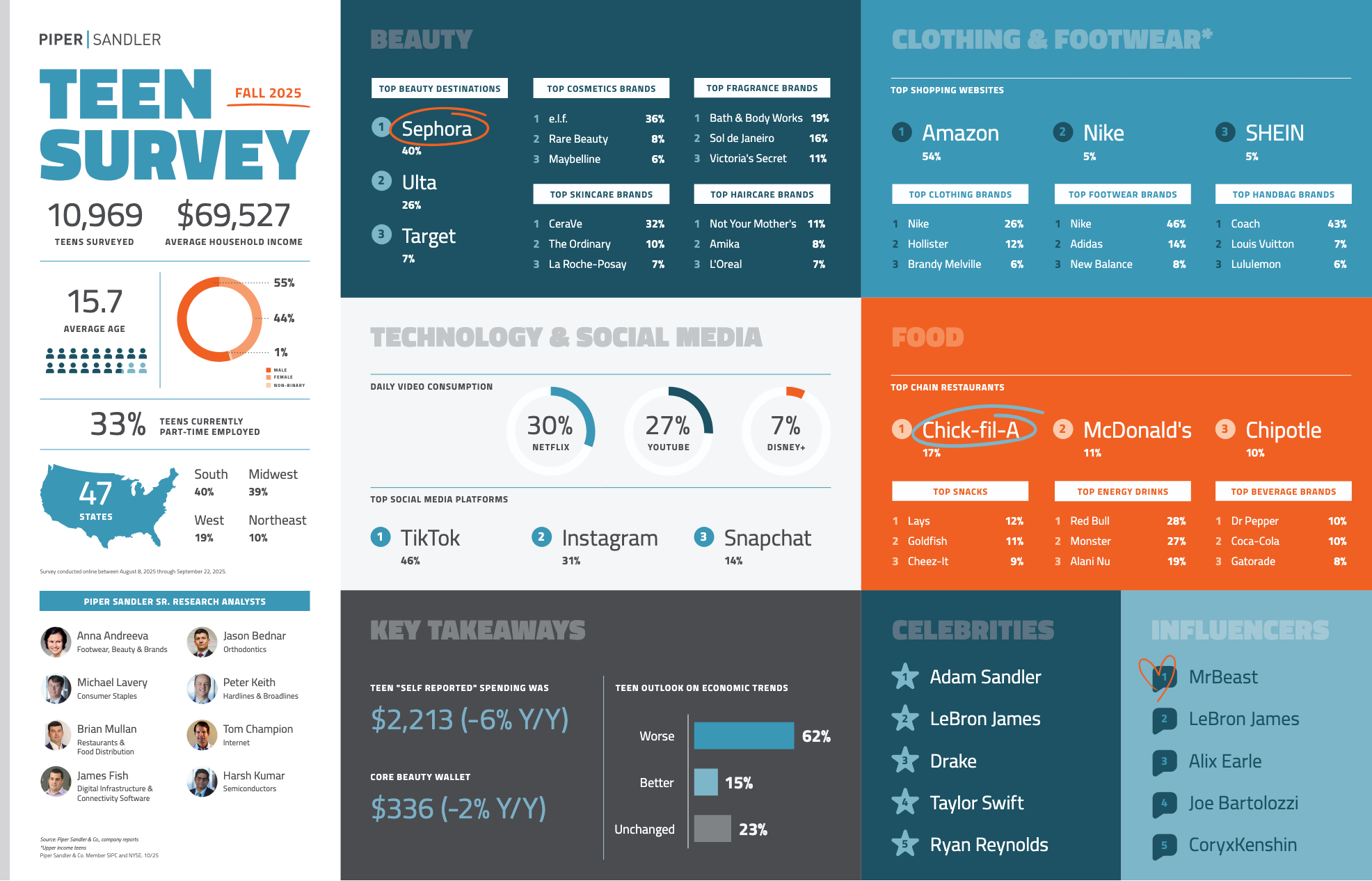
Key Findings & Takeaways
1️⃣ Economic Pessimism is informing choices
62 % of teens believe the economy is getting worse (up from 57 % last spring); only 15 % say it’s improving.
Annual self-reported spending fell 6% YoY to $ 2,213 (the lowest since the pandemic era)
Tens feel* poor (which makes sense given AI is taking their side hustles, stagnated wages … reasons go on and on) which are driving cutbacks in discretionary spending like beauty and fashion
PWC is predicting that GenZ will slash holiday spending by 23%
👉 Why it matters: In a world where chaos and instability is the norm … a “purchase” is one of the few ways to exert choice and control. They are balancing their economic pessimism with their need for instant gratification and coping.
2️⃣ Value is important
Off-price and discount shopping is up even among affluent teens. Walmart’s share with upper-income girls rose from 13% to 17%, while Target fell.
TikTok’s “when did Walmart get so good?” trend is redefining what is ‘cool’
👉 Why it matters: Accessibility and “smart value” is not only a ‘recession indicator’ but an indicator of the value mindset. While it wasn’t outlined in the study, I believe there will eventually be an equal boom in the extravagant luxury clientele too - but this will be more offline and subtle (hello, “the Row”).
3️⃣ Tech & social are still dominant, but the favorites are shifting.
TikTok ranked #1 favourite app (46% of teens), Instagram at 31%, Snapchat at 14%. For video consumption, Netflix remains #1 at 30% and YouTube #2 at 27% and Disney+ at a distant 7%.
👉 Why it matters: GenZ and A are digital generations (there is no novelty in smart phones or internet, it’s a given) - the choice lies in choosing which brand, platform, app they use. Which platform you use is not only representative of the content and world view you are exposed to, but also signals and correlates to the communities you are part of. We already see it, each of these platforms have different ‘for you’ feeds that shape teen perspectives
👾 Meet Gen Alpha
Casey Lewis steps into the world of Gen Alpha (born between 2010-2024) - the first AI-native generation.
“These kids are growing up in a world where YouTube shapes their humor, Roblox powers their social lives, and TikTok teaches them skincare before they hit middle school.”

They speak fluent algorithm and are raised in hybrid realities. As we look ahead, here are a few signals that marketers, creators, and parents should pay attention to.
✅ A Few Signals to Watch
1️⃣ Born of the Algorithm
Gen Alpha has never known a world before feeds, filters, and recommendation engines.
They expect collaborative digital spaces and curated media ecosystems where discovery feels personalized. They’re “brand-fluent” and trend-aware long before they have purchasing power — creators in training who edit iMovie shorts, curate Spotify playlists, and design Roblox avatars for fun.
2️⃣ Peer-Led Commerce Is the New Influence
Credibility is shifting from celebrities to peers. It isn’t about who you are, it’s about how (and if) you show up in the feed. Expect kids launching mini-storefronts on Roblox, TikTok Shop, or Minecraft.
3️⃣ Offline Is the New Flex
Some Alphas are intentionally seeking retro hobbies and offline escapes mirroring the “Hybrid Alpha” vs. “Matrix Alpha” divide.
4️⃣ Always-On, Layered Worlds
94% of Gen Alpha plays or watches gaming content. Screens, toys, and IRL spaces are interconnected layers and part of one experience. They expect every experience to be interactive, customizable, with consumption functioning as self-expression. GenAlpha has different assumptions: they assume access, immediacy and tools for creation.
5️⃣ Meme Fluency and Speed
Humor, self-awareness, and aesthetic coherence now define popularity more than follower counts. GenAlpha is highly brand and trend sensitive. With the speed of the internet and gaming - cultural context changes so fast, flexibility and iteration beat polish and long-lead planning.
6️⃣ Multi-Generational Influence
77% of Millennial parents say their kids shape household purchase decisions. Household choices are becoming more collaborative and a sign of a greater cultural shift.
🎮 Roblox & The Rise of Brand Sandboxes
Platforms like Roblox are no longer just games, they’re sandbox ecosystems where brands, creators, and audiences merge. Roblox’s 2025 Economic Impact Report shows some remarkable growth:
151.5 M avg DAUs (+70%)
$1.36 B in revenue (+48%)
$427.9 M paid to devs (+85%)
39.6 B hours engaged (+91%)
Why this matters for Gen Z/Alpha:
These generations don’t distinguish as strictly between “playing” and “living”. Digital worlds are social worlds. Brands such as Toyota are entering Roblox not simply as advertisers, but as world-builders. Toyota’s anime series GRIP is being brought to life inside Roblox where users engage with branded content, racing and immersive experiences.
Or better yet the example from E.L.F which continues to be the #1 Beauty brand for GenZ
For them, creation is intrinsic to identity. They don’t just watch; they make, they share, they belong.
Brands that succeed are the ones that enable. They provide the tools, the stage and the invitation, rather than only commanding the spotlight.
For brands and marketers, here are strategic takeaways:
Think world-first, product-second: Build and participate in immersive experiences with your brand. To put it very simply - listen to those who understand and exist in the communities you hope to reach on the platforms you want to explore.
Creator economy is the new retail & media: The more creators you enable, the more your brand has infrastructure and relevance. The $1 billion payout figure above underscores how serious this economy is.
Co-creation > broadcast: Let audiences participate and imagine. Brands effective in these gaming are offering sandboxes.
Measure contribution, not just impressions: Success metrics shift. Are you helping build creative capacity? Are you enabling a creator’s story? Are you embedding your brand into community flywheel rather than campaign bursts?
The future of brands is less about the one-to-many megaphone, and more about the many-to-many sandbox. In a world where Gen Z/Alpha can produce, publish and monetize from anywhere, brands need to ask themselves: Will you build the stage, or will you just be one more ad in the feed?
🗞 HEADLINES
Stranger Things Finale is showing it’s 2 hour series-finale in theatres!
China’s New Influencer strategy is only degree holders can discuss professional topics.
Justin Bieber is vulnerable and live streaming. Loneliness, vulnerability, being human .. there really is no substitute to that.
Every parent is now on the 6 7 trend, prepare for Doi Doi Doi, and of course other ‘viral lingo’
Adults are surely having romantic relationships with AI chatbots, but more concerning - a new report from the Center for Democracy and Technology found that 19% of high school students have either had a romantic relationship with an AI chatbot, or know a friend who has (recap article here).
Oh and in case you weren’t concerned enough - ChatGPT is loosening up erotica controls for adult user
AI is coming for the creator economy. I love this line “The next era of the creator economy won’t hinge on access to technology but on the intent. Those who thrive will use these tools to deepen their voice, not dilute it”.
Now, let me leave you with this.
Thanks for reading and if you enjoy, please subscribe and don’t hesitate to reach out and say HI! :)
Amazing article Abby 👏