

This week, Evan Shapiro assembled an “Avengers-level” group of kids and family media to create a comprehensive look on the state of the kids content ecosystem. Jo Redfern Emily Horgan (and many more)
There are a lot of terrific deep dives already, but I wanted to focus on what these shifts signal about behavior, and where the opportunity is heading next - especially from a marketing pov.
TLDR: Kids content is fully decentralized and fragmented.
The audience: kids and parents jump from platform (streaming, YT, social) and behave as their own curators and programmers in a largely self-directed system.
Current snapshot of Kids & Family content & behaviors:
Demand is growing, but supply (and the economics for made for kids content) is shrinking
Preschool demand alone is up +25%
Meanwhile, kids series production is down 25% since peak as streamers pull back on originals and shift risk to producers
YouTube is the center of gravity across all demographics
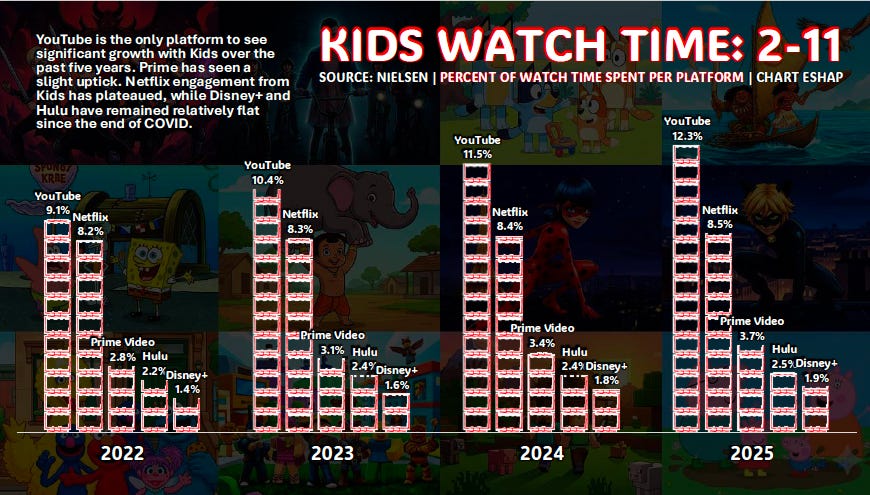
Kids 2–11 spend the most time on YouTube (#1 platform)
88% of parents say 2–5 year olds prefer YouTube over TV/streaming
70% of teens use YouTube daily
75% of GenAlpha spends more time on YT than any other platform
Year over year - YT continues to be the only platform to see significant growth in time spent (also fastest growth with 65+ demo as well)
But YouTube ≠ shared experience
YouTube leads in consumption, but lags in co-viewing (even though YT is largely viewed on TV screens)
58% of GenA watch YT on TV screens
Co-viewing is still driven by TV + premium platforms (Disney+, Netflix)
Co-viewing is still critical (and evolving)
Parents (especially Gen Z / Millennial) are highly involved in content choices
44% of kids (2–11) co-view, vs 24% of teens
83% of kids 8–11 co-view at least sometimes
IP is more cross generational than ever
50% of Bluey viewers are over 12
Signs that IP can ‘grow’ with kids - ie. Spongebob. Kids content increasingly travels up age brackets, not just down
Library + nostalgia + repeat viewing are massive drivers
The ecosystem is global + platform-agnostic
Kids content now transcends language, geography, and platform origin
YouTube acts as both discovery engine + distribution layer
82% of American kids 8-11 are online every day
Now what… where are the kids & family audience headed? Some predictions:
1) Expect more aggressive YT creator to streamer pipeline.
Why? It is a potential ‘win/win’ experiment. Independent creators in the ‘made for kids’ environment need to build off-platform businesses and augment their current economics which are remarkably challenging - regulation, ad limits, etc. BUT the demand is there. Streamers can augment budgets and/or window their non-exclusive content. From the streamer pov - online creators can become a more affordable catalogue (with built-in audience in many cases) that sustains between tentpole IP or other content bets.
The question however is the audience willingness to see YT content continue to proliferate on streaming services. What are the audience expectations on curation and is there a tipping point?
2) YouTube is the front door and trusted brands and IP will be the long-term winners.
Why? Discovery is happening in fragmented, algorithmic environments. But when it comes to trust, safety, and repeat viewing - families still gravitate toward known IP and curated ecosystems. Again this goes back to reflexive decision making and ultimately IP helps make the decision making of picking something ‘curated/safe’ to watch much easier.
4) Self curation is guided by algorithms. Expectations for parents to curate/ vote down/ “see less of” in kid environments.
Expect savvy platforms like Netflix to continue to evolve more parental features within their kid environments to allow for more customization. I.e. personalized down-voting or opting out of certain content. They already have algorithmic filters in place - but providing audiences with ‘agency’ or even the illusion of choice and opinion is very important.
Why? Platforms set the baseline for content - but in more ‘curated’ or walled- environments like Netflix, kids and parents want to feel like they are making agency within these platforms. For example - Netflix’s strategy of YT curation to their platform pipeline is working very well (Danny Go, Ms. Rachel, Mark Rober) whereas some creators are more polarising. Ex here. The real programmer today is the feedback loop between user + platform and how they allow more individualized filters.
5) Co-viewing or cross-generational viewing will be one of the only ways things can go ‘broad’.
Even in a fragmented world, shared viewing is still one of the strongest drivers of engagement, trust, and longevity. Platforms seem to align with consumption patterns
YouTube = individual consumption
Disney+/Netflix = more coviewing/ shared viewing.
Streamers will need to figure out how to keep people engaged on a day to day individual basis (they’re betting on verticals /and here, YT creator pipelines etc.), whereas YT will need to solve for how to get the tentpole shared experiences/culture (they’re betting on sports, even oscars). And yes, doing both is the key to direct to consumer business obviously.
6) Known brands and IP have a significant advantage in this fragmentation era, if they move fast.
Expect the sequel/ remake IP system to take over the kids and family space. IP awareness and big brands will have a leg up initially, cause discovery in the era of fragmentation is very challenging.
This is not saying incumbents that understand culture, speed and platform rules of the road can’t break through, just more difficult since platforms ultimately feed what is already successful and loop it. BUT the point is - the winners in this game will know how to create both short immediate feedback loops i.e. usage frequency as well as time spent. Along with trust through curation, offline, complementary experiences.
7) Each platform has its unique value proposition. Cross platform visibility is essential for IP building.
The name of the game is not to reach everyone through one platform - but to create as many brand surfaces as you can to assemble the maximum possible audience.
Why? Jo Redfern has said it numerous times - “exclusivity” is a way to obsolescence. And tbh, content is no longer the differentiator, it is memorability, resonance and trust that are monetizable.
THINGS I’M THINKING ABOUT:
In lieu of a more structured thesis, just assorted things I’ve been reading, noticing, and connecting:
Creator Economy ≠ Equal Opportunity
The digital economy hit $4.9T but the distribution is still wildly uneven. Nearly half of creators make under $10K annually, 45% sit between $10K–$100K, and only 6% break into six figures. There’s talk of a “creator middle class,” but this still looks more like a power law: a few massive winners, and a very long tail grinding it out.
Are screens the problem or does it just amplify neglect?
There is an ongoing debate about the impact of screen time. Some research shows links between screen time and developmental harm, while large-scale studies (like Oxford’s) find no clear harm. The answer is probably more complex. Screens don’t exist in a vacuum and they undoubtly amplify underlying conditions like loneliness, anxiety, or instability. Screens and social media are tools and responsibility is on adults and systems that haven’t quite caught up.
Living Online (Without Giving Everything Away)
I’ve been thinking more about how to be online… without fully giving myself over to it. Everything we post from photos, videos, likeness are increasingly training data for GenAI. Writing feels different (for now), but it does feel like we’re approaching a new boundary: not whether you’re online, but how much of you is.
Teens + Chatbots = is not a novelty it is something deeper
Millions of teens are using chatbot apps like Character.Ai, and spending hours talking to bots and building storylines, flirting, fighting, passing time. This is not a novelty, it’s the result of loneliness, control and fear of real vulnerability. Kids are forming relationships with AI companions.
Where Culture Lives (vs. Where Decisions Get Made)
Been thinking about this specific line from an interview with Alyssa Ackerman, social for SheaMoisture → “That disconnect between where decisions are made and where culture actually lives… is the root of most campaign misfires.” The best marketing is always guided by deep understanding and care for the audience.
The Liberal Arts Comeback
The future is about how you think, not just what you know. In the age of AI - natural language, skills like critical thinking, adaptability, and communication are becoming more valuable. Tech leaders are starting to hire for EQ and curiosity and not just technical ability.
YouTube Shorts & The Fragility of Discovery
YouTube is testing controls that could limit Shorts views- where users can set shorts viewing to zero minutes! This is difficult for creators because shorts are a key discovery engine as a funnel into long-form content. This once again proves that discovery and platforms are very volatile. For creators - if you don’t own your audience beyond the feed (and are not diversified), you don’t really own your growth.
CEO to creator pipeline
Since the McDonalds CEO content that kickstarted a socioeconomic debate as well as a burger eating trend I can’t help but notice all of the CEO to creator pipeline brands and efforts (even blackstone). Once again, transparency, trust and accessibility continues to be the underlying theme…but personally, I’m sick of ceo fancams, just stop please.
Now, let me leave you with this.
Thanks for the shout Abby, the things that you are thinking about are the things I'm thinking about too. Will we see a return to TV-like scheduling/curation for kids, but at scale? And how do we join on screen and off screen experience in a way that each makes the other feel equally valuable?