

Someone asked me recently - what have you learned about how younger audiences discover and engage with content? It’s a huge question, but the short answer is this… for younger generations, ‘digital’ and the ‘internet’ is not a destination - it’s the world itself. Social media IS media. Gaming IS community. And increasingly, their identities are shaped by how seamlessly they move between digital and real life. But within Gen Z and Alpha, there’s a growing divide - between those who can toggle between the two, and those who can’t tell where one ends and the other begins. That tension between connection, control, and reality is shaping how they build trust, what they crave from entertainment, and how brands will need to show up next.
🧠 The Split in Gen Alpha: Regulated vs. Unregulated Tech
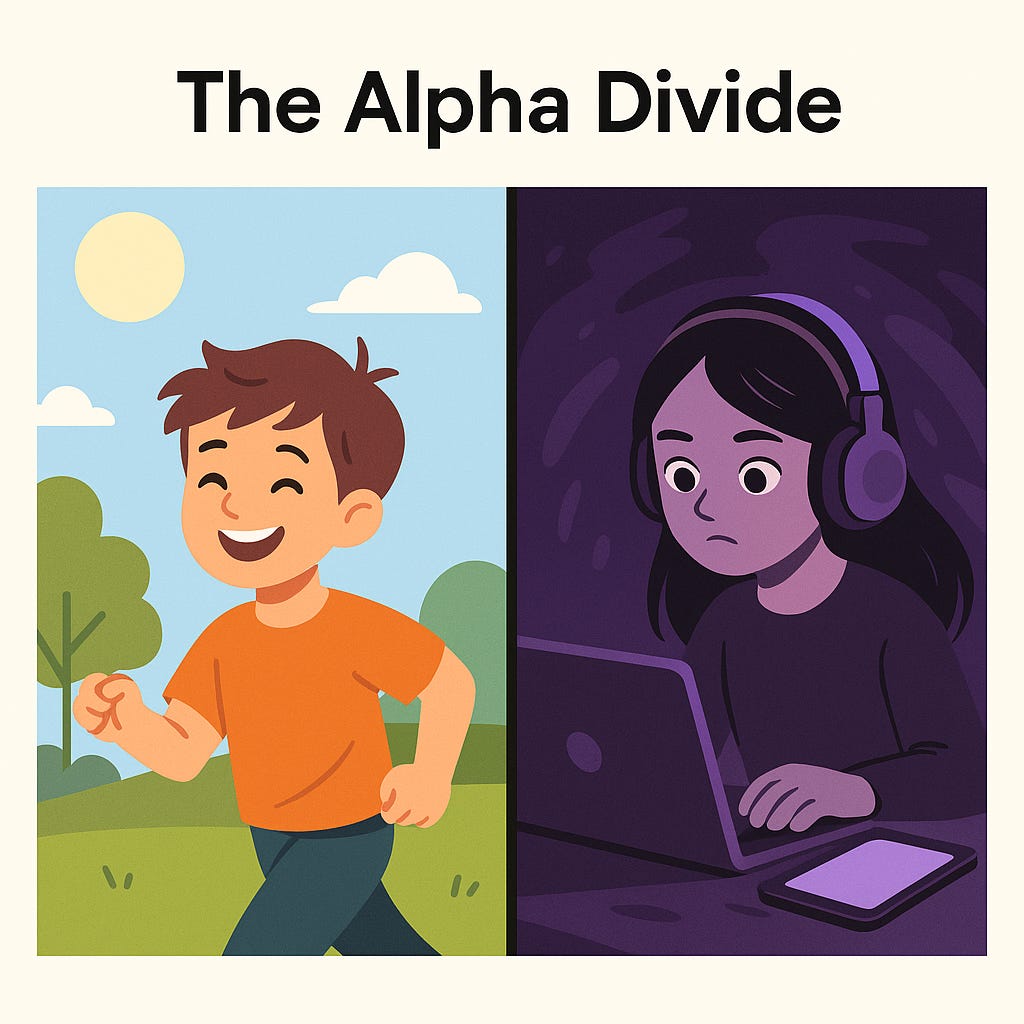
GenAlpha is the first true all online, all digital generation. GenZ has the ‘zillennial’ cohort, and to plainly state it - the covid-trauma cohort, which is probably more similar to the Alpha. Labels aside, remember that the oldest Alpha cohort is 15. And it is going to become more evident kids that head into their teen years that have rich digital and real lives, and those who have escaped entirely online. My prediction the establishment of two broad cohorts-
Hybrid Alphas will come from homes with strict adult/parental controls, regulated screen time, content filters, and supportive offline habits. They’ll have more developed social, emotional, and self-regulation skills. Emerging studies hint at this already. For instance - this is a study from India found that higher screen time was negatively correlated with academic performance and positively correlated with anxiety and behavioral issues. This study from Canada suggests that pre-schoolers had cognitive differences in memory related to the amount of screentime.
Matrix Alphas will be guided entirely by algorithmic loops. They will have been exposed to toxic content slip-ins and unfettered use. They may struggle more with attention, mental health, social comparison, and digital identity. Very early use and/or exposure to immersive AI without critical thinking might also be in this category. The American Psychological Association also identified that excessive screen time especially via video games was linked to social and emotional problems among children aged 6-10.
This split matters because which side of the line an Alpha falls on could determine their tastes, trust, brand preferences, and how receptive they are to marketing and the world around them.
📈 What This Means for Brands & Marketing
Segmenting by experience, not just age.
Marketing to Gen Alpha won’t be enough. If we thought reaching GenZ was tough it’s gonna get even more difficult with Alpha. You’ll need to understand which side of the divide we’re speaking to. Messaging, frequency, content severity, and exposure expectations will need to shift. And of course, for the former camp - hybrid alpha’s don’t forget you’ll also need to speak with parents and caretakers in parallel to increase chances of conversion.Brands as safe guides in the gray zone.
For Matrix Alphas, brands that act as filters or trusted guides (curating content, moderating toxicity, offering learning + play) will earn trust. For Hybrid Alphas, brands that can safely introduce (with transparency and control) new worlds will have the advantage.Playing offline-forward.
Because a cohort of Alphas will crave non-screen experiences or breaks, brands that design phygital experiences as well as IRL touchpoints, hybrid gaming popups, limited offline rituals will earn trust..Transparency, controls & child-first design.
Trust will come from letting guardians and Alphas see, adjust, and understand brand systems. Brands that build in visible control, explain “how AI works,” and are accountable for safety will be rewarded.Long-game reputation over short viral hits.
Because the experience gap will be so wide, consistency (safe, responsive, empathic branding) becomes more and more critical. Once again, say it with me - TRUST. Expect flashy stunts to have shorter and shorter newscycles and watch as more brands realize that it is in the day to day, and long relationship game that will pay of (literally).
🔮 Trends I Predict
“Light mode” versions of digital brands - stripped-down, less addictive, offline-leaning variants for protected Alphas (e.g. Minecraft create mode or other safety features, YouTube Kids, Netflix Kids etc.).
Digital detox / guided timers as features, not afterthoughts - brands that help children build healthy screen habits.
Dual campaigns: “guided” and “wild” paths - Minecraft, Fortnite (most games) all have at least some dual experience - creator led modes and game, or story modes allowing for duality and agency in how you want to insert yourself into worlds.
Brands need to concurrently educate and bridge - bridges between offline skills and online fluency. There is already a rise in ‘educational’ influencers or “expert-influencers”. This is a direct response to traditional institutions which are less equipped or prepared to help people distinguish between ‘real’ and ‘algo’. The speed of consumption and culture is hard for large moving institutions to keep up.
Brands need to reach adults and kids at the same time. Parents as co-strategists. Millennial parents are increasingly aligning with their kids’ tastes (and note most Alphas have millennial parents). 77% believe their children hold more purchase power, and nostalgia is a bridge. Marketing Dive
Community + relevance > creator fame. Rather than chasing macro-influencers, Gen Alpha responds more to microinfluencers whose content feels aligned with their interests - not because they’re famous. The same logic same goes for ‘traditional celebrities’. Expect celebs to have less’ influence’ with this Alpha cohort. There will be a STEEP diminishing effect with ‘traditional media stars’ vs. peer influence.
Offline-world experiences - no surprise here, but even the hybrid Alphas will live their real lives as ways to extend and immerse and turn digital interests into something tangible.
🎥 Streaming or Real Life? The New Spectrum of Experience
This leads me to another world blending question. I came across this great tiktok that talks about the future of entertainment and she mentions that it is either streaming or in real life. And I mostly agree, but for younger generations I think the tactics are more nuanced. To me - with Alphas and GenZ it is more about what garners CONNECTION. What streaming and IRL solve for is loneliness. And for brands as they create their plans - it’s not only about “screens” and the “world” - it’s about how you can get your brand to solve and create CONNECTION.
Streaming, gaming, and IRL experiences all feed the same craving: belonging. Social media = media. And Gaming (and streaming) is all about community and immersion.
Streaming is their digital hangout. Instead of swinging by their neighbor’s house - it’s about finding connection and intimacy. They’re not watching for content - they’re watching for company. Long-form “hang” streams replicate friendship energy, the background noise of companionship.
Social media has become the new distribution pipeline. Content algorithmically delivered that can let them feel part of culture and to be entertained. It’s participation through ambient belonging. The content delivered on social media is equally important as the comments section.
Gaming is the middle ground. Shared creation and play, the truest hybrid of online and offline. Multiplayer spaces like Roblox or Fortnite aren’t escapism; they’re digital neighborhoods.
IRL experiences (fan events, pop-ups, concerts) are physical proof that the connection is real.
What ties all of it together isn’t medium, it’s emotion. Gen Alpha and younger Z are seeking unfiltered, participatory, emotionally reciprocal experiences. Whether that happens through a livestream, a shared world, or an IRL crowd.
For brands, the takeaway is this: stop thinking about “digital vs. physical” channels. The future of engagement lives in continuity. Letting your audience move seamlessly from watching to participating to belonging.
📰 Headlines, Headlines!
Trust vs. Novelty. This article dives into how fashion brands are leveraging novelty, absurdity to stand out. And questions if we are reaching ‘hype fatigue’ and asks if it is time shift from meme-attention baiting stunts to deeper more meaningful connections. “It’s no longer enough to provoke. Attention grabs must balance with recongnizability – a unique and distinctive identity.” - absolutely brilliant article.
Social media is MEDIA. this graph and this discussion in the comments section was enlightening. Caveat that tiktok data was not included in the social media graph (which makes it appear like there is a decline). That said - the big takeaway for me is that GenZ and younger generations are moving to other platforms for community (GAMING!), and utilizing social media as a means to consume or ‘lean back’ to watch vs. share.
🎥 YouTube’s Growing Grip on Entertainment. YouTube works because it is a platform that houses entertainment content. It is a flywheel that continues to give audiences a curated and entertaining experience. It puts audiences at the center of their own experiences - I’d argue this is a similar experience to what audiences get from Netflix. The only difference is that YT takes on none of the risk of investing in the content that fills it’s platform.
🧸 Bluey, Cocomelon, Peppa and the K-Pop Kids Content Pipeline. Emily Horgan, Nicolas Eglau, Esra Cafe and numerous Kids and Family media vets outline the unique challenges and tension that exist in trying to build global franchises in a time where budgets and fragmentation make the economics more and more challenging.
Now let me leave you with this just for fun. And for the record, I know EYECONs are into the Yoonchae Acelerada trend now - but I still love this edit of Daniela. I love the way it’s cut and watch from my saves.
Thanks for reading! And if you have any questions, or suggestions on what to cover next- comment and subscribe.