

I’ve been chipping away at this post for weeks. And to be honest, it’s still a work in progress, but I should take my own advice and build in public, yeah?
Lately, I’ve been thinking a lot about what marketing to Gen Alpha will actually look like. Not simply what platforms, trends, or games they’re into, but whether a generation growing up inside algorithms, creators, AI, and infinite content requires us to rethink the marketing playbook itself. Spoiler alert, yes - I think there are some new rules.
To wildly oversimplify - Boomer and Gen X-era marketing was largely built around mass messaging and distribution. Millennials ushered in brand narrative, storytelling, and conversation. Gen Z accelerated speed, cultural fluency, and participation across fragmented feeds and timelines.
But for Gen Alpha they will inherit all of these approaches simultaneously, with AI transforming how content is created, discovered, coordinated, and interpreted.
The good news is that the fundamentals of marketing haven’t changed. Positioning, storytelling, creative, and distribution still matter. What has changed is the strategic dexterity required to make them work together inside a fragmented, algorithmic, and increasingly AI-mediated ecosystem.
So after a fair amount of drafting - I’ve boiled my Gen Alpha Marketing Playbook down to six rules:
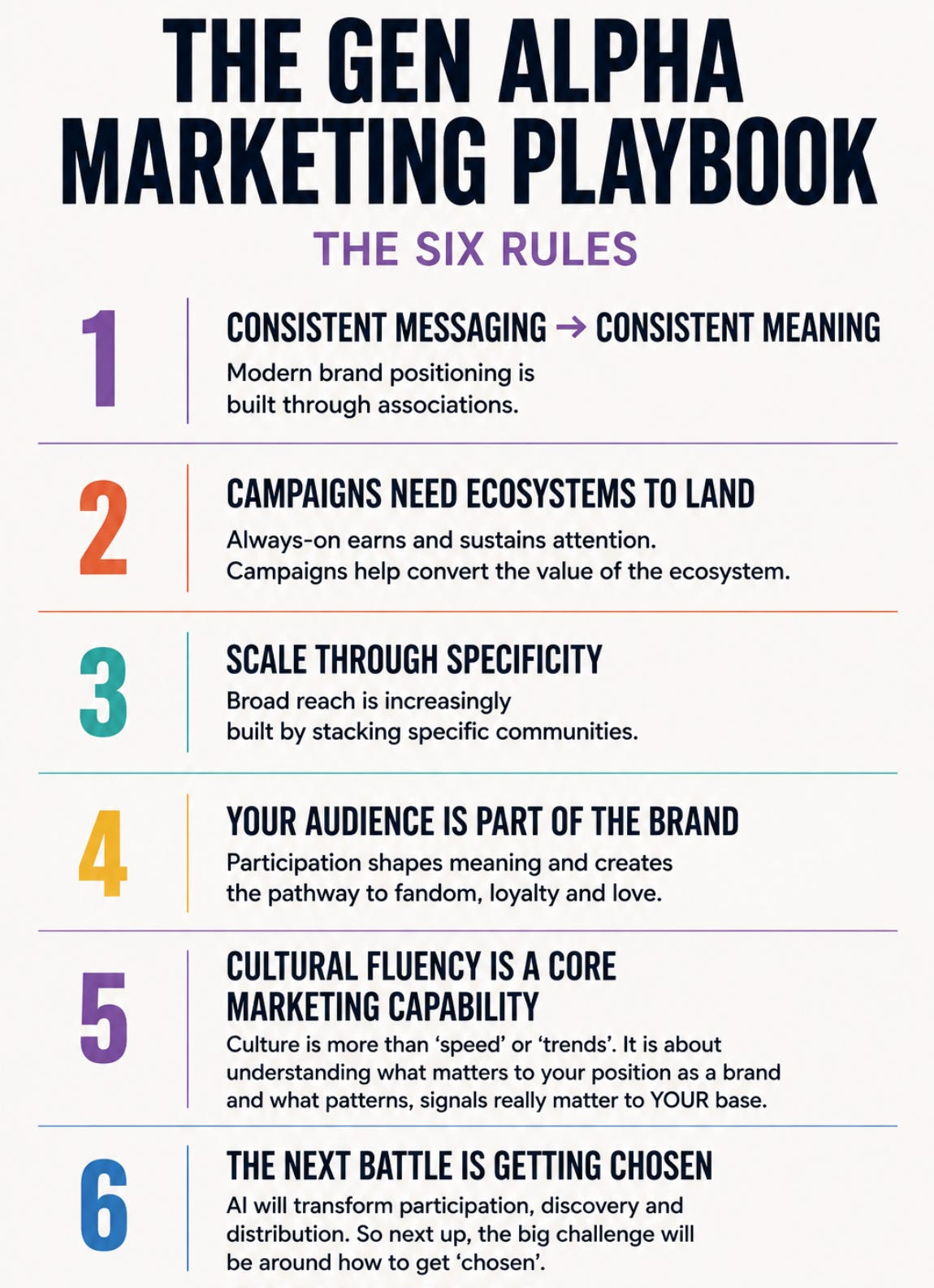
THE SIX RULES
1. Consistent Messaging → Consistent Meaning
Modern brand positioning is built through associations.
2. Campaigns Need Ecosystems to Land
Always-on earns and sustains attention. Campaigns help convert the value of the ecosystem.
3. Scale Through Specificity
Broad reach is increasingly built by stacking specific communities.
4. Your Audience Is Part of the Brand
Participation shapes meaning and creates the pathway to fandom, loyalty and love.
5. Cultural Fluency Is a Core Marketing Capability
Culture is more than ‘speed’ or ‘trends’. It is about understanding what matters to your position as a brand and what patterns, signals really matter to YOUR base.
6. The Next Battle Is Getting Chosen
AI will transform participation, discovery and distribution. The next big challenge will be around how to get ‘chosen’.
RULE #1: Positioning is built through associations. Consistent meaning > consistent messaging.
As distribution and discovery continues to disintermediate and fragment, positioning is everything. A brand needs absolute clarity on its purpose, the value it provides, the territory it can credibly own, and ultimately the feeling it wants people to associate with it.
Are you the challenger? The expert? The trusted category leader? The rebellious alternative? Strong positioning gives audiences a clear mental shortcut for understanding where you fit and why you matter. And most of all - how you make them feel.
Historically, marketers created consistency through repetition: a singular campaign idea, or a literal tagline and message reinforced across every channel. But younger audiences are now inundated with disconnected (and often endless) touchpoints - creators, feeds, products, games, memes, collaborations, retail, AI agents… the list goes on! Trying to force the exact same message through every one of those environments limits the cultural and contextual relevance that makes each touchpoint effective in the first place. And if i’m perfectly honest - it’s inauthentic and BORING.
So the strategic objective shifts from consistent messaging to consistent meaning.
Gap offers a perfect example. Its recent comeback has been built around renewed brand love and cultural relevance, but those ideas take different forms depending on where audiences encounter the brand.
The KATSEYE campaign establishes a broader cultural mood by combining emerging global talent, dance, fashion, and the nostalgia of Kelis’ Milkshake. That then ripples outward through TikTok tutorials, choreography, styling, creators, conversation, and countless audience interpretations.
What holds it together isn’t a repeated tagline. It’s the associations accumulating around Gap: self-expression, style, familiarity with a touch of surprise, cultural participation, and a renewed sense that the brand belongs in the conversation.
That’s the shift I’m interested in:
Different expressions but shared meaning, shared associations.
Great modern brands don’t recite taglines, they create shared feelings and instincts about what the brand means.
RULE #2: Campaigns Need an Ecosystem to Land
Rule #1 is about defining the associations you want to own and to build on this Rule #2 is about building and reinforcing them over time.
In a feed-based world, there is no clear beginning, middle, or end to how someone experiences your brand. Yet much of marketing (especially where money is spent) is still organized around campaigns. The practice is to build toward a launch, concentrate media and creative around a moment, then move on to the next one.
Campaigns still matter enormously. They create urgency, concentrate attention, and give brands permission to make bigger creative and cultural statements. But increasingly, the campaign shouldn’t be responsible for creating the relationship from scratch.
That’s the role of the ecosystem.
Your always-on content, creators, community engagement, product conversation, partnerships and cultural participation are constantly teaching people what your brand means. Done well, those everyday interactions reinforce the positioning from Rule #1 and steadily accumulate familiarity, affinity and goodwill.
Then the campaign gets to cash in on that accumulated equity.
BÉIS is a great example. Its brand isn’t built only during major launches. Between campaigns, BÉIS is constantly reinforcing what it stands for through travel content, creator relationships, product demonstrations, founder personality, customer conversations and an unusually active feedback loop with its community. The brand has even turned TikTok comments and complaints into inputs for product development.
So when BÉIS launches a new product, collaboration or experiential stunt, it isn’t starting at zero. It’s activating a community that already understands the brand, already has a relationship with it, and already has reasons to participate.
That changes how I think about the role of the campaign:
Your ecosystem builds the brand every day. Your campaigns give that brand moments to convert.
RULE #3: Scale Through Specificity
Broad reach is built by stacking specific communities.
For decades, scale meant finding the broadest possible message and distribution. Internet culture works differently because audiences increasingly organize around interests, identities, creators, aesthetics, fandoms, and communities rather than simply demographics.
So scale increasingly comes from stacking niches.
You don’t necessarily need 50 million people to love you for one reason, but you DO need communities of five million people with personal and positive associations to LOVE you.
Think about Crocs. Fashion people may encounter the brand through a collaboration. Kids through characters and Jibbitz. Sneaker culture through limited drops. Creators through personalization. Parents through utility. None of those motivations are identical, but collectively they expand the cultural surface area of the brand.
This is something the creator economy understands instinctively. Creators often become enormous precisely because they begin with specificity. They understand one community, behavior, language, or need deeply enough to earn credibility and then expand outward.
Specificity creates affinity. Stacked affinity creates scale.
And that’s why cultural fluency matters. Authenticity doesn’t come from learning how to “sound Gen Alpha.” It comes from understanding the specific community you’re entering…its language, references, motivations, behaviors, humor, and unwritten rules. You need to contribute something of value before you can convert.
RULE #4: Your Audience Is Part of the Brand
Participation increasingly shapes meaning.
If you only remember ONE thing from this post- it’s that control is a thing of the past. This may be the biggest philosophical shift in the playbook.
Brands once had considerably more control over creating and distributing meaning to audiences. But now - audiences are an integral part of the ecosystem and fuel the brand..
They post, engage, meme, react, criticize, theorize, create content, invent language, build communities. And occasionally decide that the completely unintended part of your campaign is the part everyone cares about. Ecosystems with real audiences are alive.
The audience isn’t simply downstream of the strategy anymore. They’re part of the brand system.
This is why I keep coming back to participation as the bridge between audience and fandom:
Discovery → Participation → Community → Fandom → Franchise
Discovery gets someone through the door. Participation creates investment. Repeated participation creates shared culture. And over time, that shared culture can become identity and that translates into fandom.
BTS is a great example of this. The music matters enormously, but being “army” is an identity. It is built off of theories, rituals, fashion, fan accounts, collective anticipation. The audience doesn’t simply consume the story - there is a deep ‘parasocial’ participation that becomes part of the story.
This also requires brands to become more comfortable with interpretation. Audience response will be messy. Criticism, parody, debate, and unexpected interpretations aren’t inherently opposed to business outcomes.
The strategic skill is understanding what participation is telling you and knowing when to respond, when to amplify, and when to get out of the way.
Reach and distribution can be bought, but as the landscape and attention continues to fracture - LOVE, trust, fandom are the true commodities. And all of that - is earned.
RULE #5: Cultural Fluency and Interpretation Is a Core Marketing Capability
We have more audience data than we’ve ever had. But data is much better at telling us what happened than explaining why people cared. Why did this creator resonate? Why are kids suddenly obsessed with this seemingly random thing? Answering those questions requires more than social listening. Listening has to evolve into interpretation.
And interpretation requires immersion, critical thinking and pattern recognition.. You have to actually consume the culture and spend time in the communities you want to understand. We need to watch the creators, read the comments, understand the fandoms and understand the platforms.
Especially as culture fragments into thousands of niches, cultural fluency isn’t knowing every trend - it’s having the pattern recognition to know which signals matter to your brand.
Gen Alpha is a perfect example. A surface-level interpretation of “Sephora Kids” is that younger audiences like skincare. A more culturally fluent read connects it to algorithmic exposure, identity optimization, creator influence and kids entering traditionally adult cultural spaces earlier. That’s the difference between spotting a trend and interpreting what it signals. When we start from the signals - you can build a durable brand that can address the underlying need state and ultimately rule #1 to land a consistent association (and this goes beyond just GenAlpha).
In the future, the most valuable marketers in the next decade are going to be great storytellers and great interpreters. They’ll recognize emerging behaviors, understand the human motivations underneath them, and translate those insights into action quickly.
We also saw this play out at the World Cup, where creators gave brands the flexibility to respond to breakout players, unexpected results and cultural moments while the tournament and culture around it as it was happening in real time.
Listen → Interpret → Test → Learn → Adapt. That’s the kind of speed that matters - the curiosity and cultural learning speed.
RULE #6: The Next Battle Is Getting Chosen
Distribution is evolving into coordination.
And now it’s time to address the elephant in the room… AI. Rules #1-5 are really about building a modern and durable marketing system, but rule #6 is about what’s to come.
Doug Shapiro recently made an argument that I haven’t stopped thinking about: media power has historically shifted between those who create content and those who distribute it. But in the fragmented present (and future) the valuable layer is coordination aka influencing what people actually choose.
Take for example - YouTube, TikTok, Spotify, Netflix and Amazon don’t simply give us access to infinite options; their algorithms help decide what we see next. Distribution gets something in front of us. Coordination and relationships influences what gets chosen.
AI will disrupt that relationship again. Instead of opening Netflix and scrolling through recommendations, I might eventually ask an AI agent: “My kids and I have 90 minutes. They liked X and Y, nothing scary, and we’ve already watched Z. Find us something.” Suddenly discovery can happen above individual platforms, informed by far more context about who I am, what I like, and what I need in that moment.
And this is where the first five rules become even more important. If AI makes content creation easier while simultaneously filtering more of what reaches us, being understood, differentiated and chosen becomes the real competitive advantage. Strong positioning gives you meaning. Ecosystems create signals. Niches create specificity. Participation creates affinity. Cultural fluency keeps all of it relevant.
AI doesn’t replace the playbook. It raises the stakes. Because in a world of infinite content, creating becomes easier while getting chosen becomes harder.
Conclusion: So, What Does the Gen Alpha Playbook Actually Require?
The good news is that Gen Alpha doesn’t require a brand new form of marketing. The fundamentals of marketing - positioning, storytelling, creative, distribution and understanding human motivation still matter. What changes is how we bring all of these things to life.
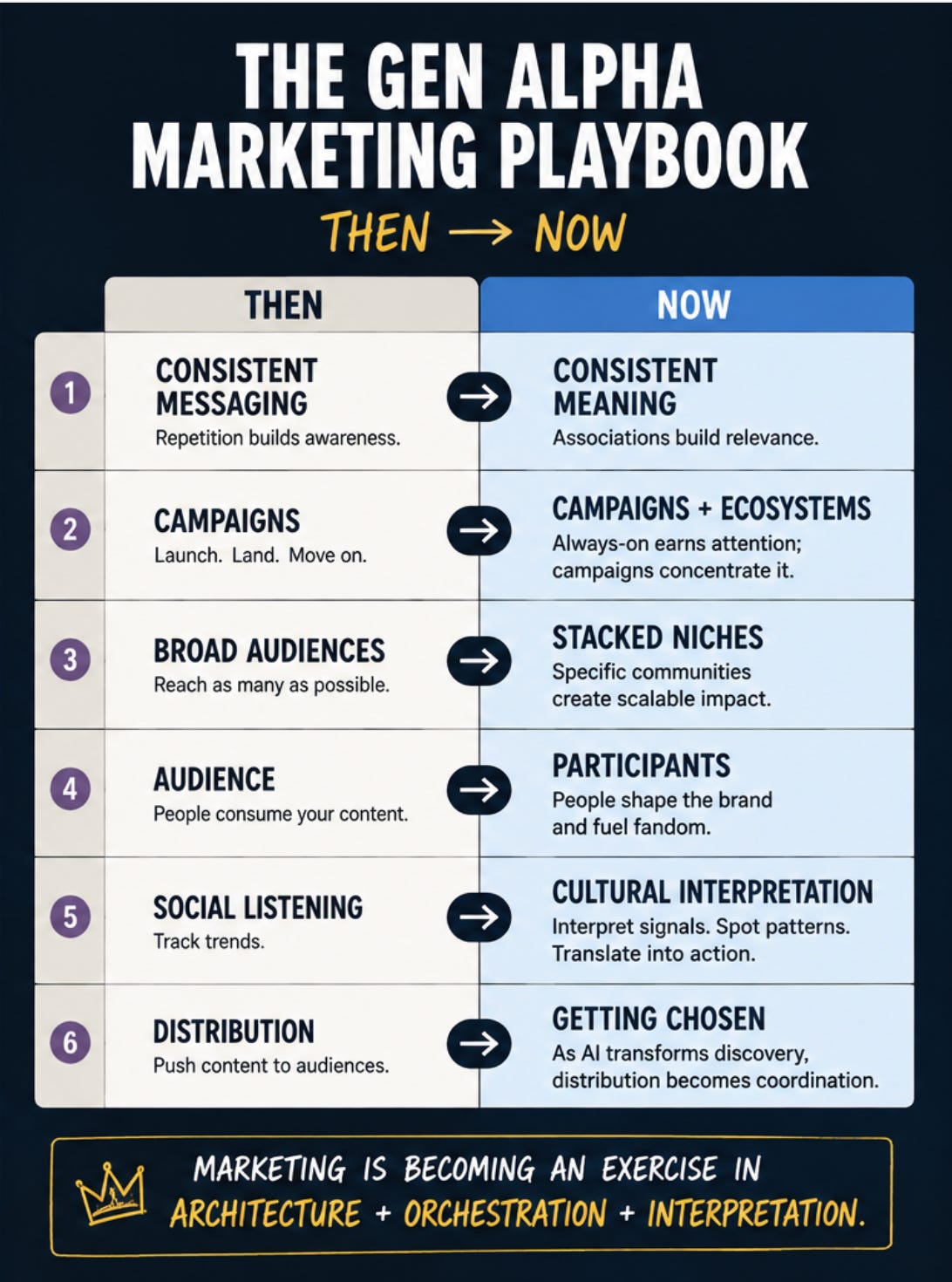
Marketing increasingly feels like a discipline of architecture, orchestration and interpretation: building a coherent brand system, connecting the pieces across audiences and touch points, and understanding culture well enough to continually adapt. As AI makes content more abundant and discovery more mediated, that ability to connect the dots will become essential.
Audiences experience the sum of touchpoints as one brand. So to reiterate - just know that Gen Alpha playbook is actually pretty simple: Know what you mean. Understand who you’re trying to reach. Build the architecture around them (the way they experience the world!). And orchestrate it into something worth choosing.
Now let me leave you with this…